
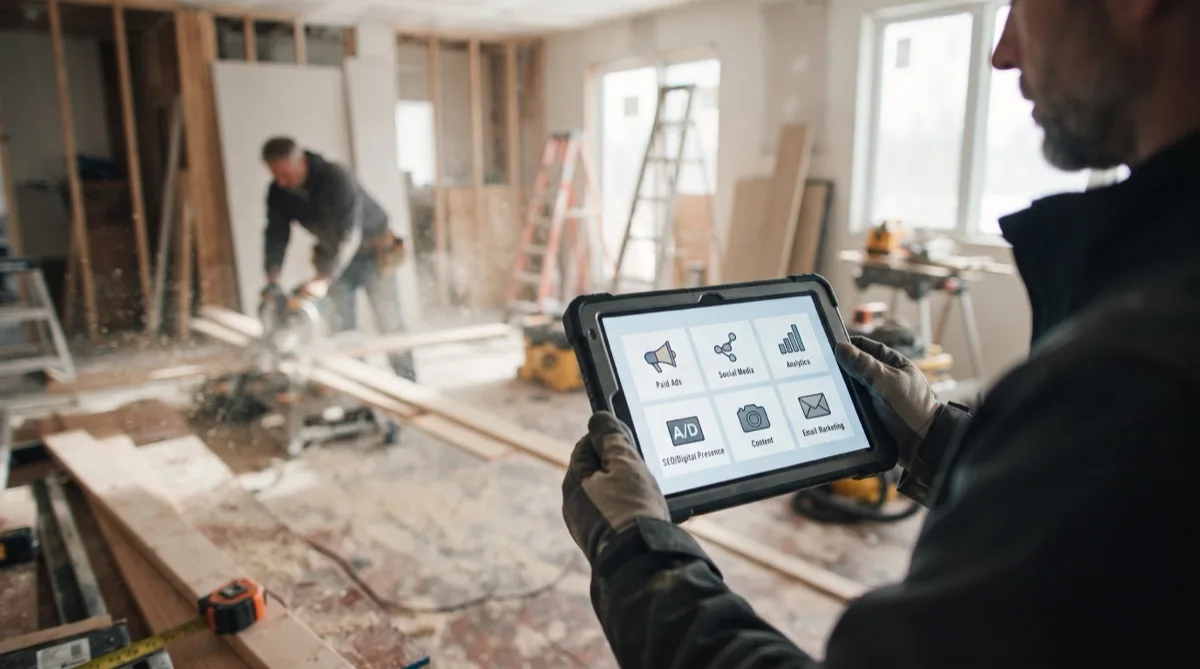
Residential kitchen and bath spending in the US is expected to reach $235 billion in 2025, and 91% of homeowners hired professionals for their remodeling projects in 2023 source source. The remodelers who win are not the ones who spend the most; they are the ones who build a digital marketing system where each channel supports the others. This guide is that system, designed for the owner or in-house marketer who wants to run it themselves.
If you are evaluating whether to hire an agency instead, our remodeling marketing agency guide walks through how to choose the right partner. For the done-for-you version of the stack below, see our SEO and marketing services. When you are ready to talk strategy, book a call.
The Remodeler Digital Marketing Stack
Think of your channels in layers. Each layer has a different speed and cost, and together they cover the full buyer journey.
| Channel | Primary Role | Typical Cost Signal | When to Use |
|---|---|---|---|
| Local SEO + Google Business Profile | Capture existing local demand | Time and labor, low direct spend | First; foundation for everything |
| Google Search Ads | Immediate high-intent leads | $7.85 average CPC for Home & Home Improvement source | When you need leads this month |
| Google Local Services Ads | Pay-per-lead calls | $25–$80 per lead source | Parallel with Search Ads |
| Facebook/Instagram Ads | Inspiration and retargeting | $41.26 CPL for Home & Home Improvement source | After search is profitable |
| Email Marketing | Repeat business and referrals | $36–$40 return per $1 spent source | Once you have a customer list |
| Review Management | Trust and conversion layer | Time and systems | Always running |
The most common mistake is starting with the shiny channel and skipping the foundation. A beautiful Instagram feed does not help if your Google Business Profile is unclaimed.
The second most common mistake is underfunding the whole stack. The SBA recommends that companies under $5 million in revenue spend 7–8% of revenue on marketing, yet Buildern’s 2026 residential construction report found builders actually spend 1.8–3.2% across most regions. Most remodelers are not out-marketed; they are under-invested.
Layer 1: Local SEO and Google Business Profile
Start here. Local SEO captures people who are already searching for what you do, and it costs far less per lead than paid ads once it is working. 76% of people who search for something nearby visit a business within a day source.
For kitchen and bath contractors, the local playbook is specific. Claim your Google Business Profile, choose the right categories, list your service areas, and publish photographed project pages. For the full local SEO breakdown, see our kitchen remodeling SEO guide.
For step-by-step guidance, see our related resource: How to Get Remodeling Business Leads.
Layer 2: Paid Search for Immediate Demand
Google Search Ads and Local Services Ads are your fast-start channels. They put you in front of homeowners who are actively searching for remodelers right now.
Google Search Ads for Home & Home Improvement averaged $7.85 per click in 2025 source. Your actual cost per lead depends on landing page conversion rate. A dedicated page matching the ad headline can convert at 5–9%, while a generic homepage might convert at 2%. For expectation-setting: LocaliQ’s 2025 benchmarks across 3,211 US home services campaigns put average search cost per lead at $90.92, with Construction & Contractors at $165.67.
For a breakdown of costs and pricing, see How much do remodeling leads cost?.
Local Services Ads charge only when a homeowner contacts you. Costs have climbed 40% in competitive markets since 2023, and 70% of contractors now use them, so the bar for positive ROI is higher than it used to be source. Expect $25–$80 per lead depending on trade and market. The booked-job math still favors LSAs: a SearchLight Digital study of 888 contractors found LSAs averaging $53 per lead and $233 per paying customer, booking at 43.9% with a 7.84x closed return on ad spend — the cheapest verified paid path to a booked customer.
Layer 3: Social Ads for Inspiration and Retargeting
Facebook and Instagram are not usually the first lead source for remodelers, but they are powerful for retargeting and lookalike audiences. Home & Home Improvement lead campaigns on Facebook averaged $41.26 per lead in 2025 source.
Cheap leads are not cheap customers, though. 2026 contractor acquisition-cost data shows Facebook producing some of the most expensive customers at $300–$500 each and Google Ads campaigns for cabinet businesses at $300–$400 blended, versus $50–$150 for mature SEO and under $50 for referrals — an elevenfold spread separates the cheapest channel from Angi at $542 per customer. That is why Facebook earns its place as an inspiration and retargeting layer, not a standalone acquisition engine.
The creative is different from search. Where search ads answer a specific query, social ads must interrupt with something worth stopping for. Use real before-and-after photos, short video walkthroughs, and soft offers like “See 10 Kitchen Design Ideas” or “Calculate Your Remodel Budget.”
Layer 4: Email Marketing for Repeat and Referral
Email is the most underused channel in remodeling. It is also the highest-ROI channel when you have a list. Industry benchmarks place email marketing at a $36–$40 return per dollar spent source.
For remodelers, email is not about newsletters. It is about:
- Post-project follow-ups asking for reviews and referrals.
- Seasonal maintenance reminders for past clients.
- Anniversary emails one year after project completion.
- Referral program announcements to your best clients.
A 500-client database is a marketing asset most remodelers underuse. Home and building services email open rates run 40–45%, well above cross-industry averages source.
Layer 5: Review Management as the Trust Layer
Every channel above depends on reviews. BrightLocal’s 2025 survey found 91% of consumers read local business reviews before deciding, and most will not consider a business rated below 4 stars source. Google dominates review discovery for local services, so your Google review pipeline is a marketing channel, not a customer service afterthought.
Ask for reviews systematically. Respond to every review. Track your average rating and review velocity the same way you track cost per lead.
Speed-to-Lead Ties Everything Together
The fastest channel in the world will not save you if you respond slowly. Research shows 78% of customers hire the company that responds first source. Home services also have a 14% missed call rate, and 86% of consumers do not answer calls from unknown numbers source.
The phone call itself is the conversion chokepoint. Invoca’s 2025 call benchmarks show home services calls converting at 46%, with 37% of phone leads converting during the call itself. Channel ROI comparisons are meaningless if your call handling leaks — fix answer rates before reallocating a single ad dollar.
That means your digital marketing stack must include:
- A branded caller ID.
- A system to return missed calls within minutes.
- Text follow-up for form fills.
- A CRM that tracks lead source from click to booked job.
Who This Post Is NOT For
This playbook is not for the remodeler who wants to set up one campaign and ignore it for six months. Digital marketing for remodelers requires consistent attention to reviews, ad optimization, and follow-up. If you would rather evaluate and hire an agency to run this stack, our remodeling marketing agency guide is the right next read.
How to Sequence Your First 90 Days
If you are starting from scratch, the order matters more than the budget.
- Week 1–2: Claim and complete Google Business Profile. Fix NAP consistency across top directories.
- Week 3–4: Publish or update core service pages and 5–10 project pages.
- Week 5–6: Turn on review requests for every completed project.
- Week 7–8: Launch Google Search Ads and Local Services Ads with dedicated landing pages.
- Week 9–12: Add Facebook retargeting and set up basic email automation for past clients.
SEO will be working in the background while paid ads produce immediate leads. By month six, you should have enough data to know which channels deserve more budget and which need fixing.
Measuring the Full Stack
Track channel-specific metrics, but never lose sight of the business metrics:
- Cost per lead by channel.
- Cost per booked job by channel.
- Speed-to-lead average.
- Review count, average rating, and recency.
- Organic clicks and calls from Google Business Profile.
A $200 search lead that closes into a $25,000 kitchen remodel is cheap. A $50 Facebook lead that ghosts you is expensive. The channel that produces the lowest cost per booked job is your winner, not the one with the lowest cost per click.
If you want help building or accelerating this stack, our SEO and marketing services cover local SEO, paid search, review systems, and follow-up infrastructure. When you are ready, book a strategy call.