
More showroom appointments.
Bring qualified buyers to your design calendar.
Showrooms that got the calendar back
- Cabinet Era — a live cabinet-industry case. The full numbers are on that page.
- Bienal Custom Closets — a live adjacent-trade case. The full numbers are on that page.
From local search to a design appointment
How a kitchen or bath buyer reaches a scheduled consultation with your designers.
- Search
A homeowner searches for kitchen and bath showrooms and design help nearby.
Who acts CabinetBoost - Shortlist
Your showroom, project photos and reviews answer the first comparison.
Who acts CabinetBoost - Book
A call or form fill becomes a confirmed design appointment on your calendar.
Who acts Both - Consult
Your designers host the consultation and scope the project.
Who acts Your team
The counted step is a booked, qualified design appointment; your team runs the consultation.
The Showroom Playbook — what we do for floors like yours 6 steps
Campaigns connect local showroom searches with a page about your displays and booking a design consultation. Search-term review and qualification questions help your team assess project fit.
Maps, floor pages, and the queries kitchen buyers type when they are ready to walk a display — city, door style, design appointment. Rank in the zips the floor actually serves.
Finished kitchens and the floor itself become the creative. A stock island from a template library does not sell a sit on your door-style board.
A handful of finished kitchens and the floor they were specified on, written to book the next sit. Grain, door style, the island they will stand at — not a generic before/after slider.
A kitchen cycle is three to nine months. A form fill that sits overnight is a visit you already paid for and then gave away. Keep the sequence alive through month two and month six.
Post-install asks, vignette photos, and proof from the job help sell the next showroom visit. No review-gating — you do not leave a public review to book a call or to get photos shot.
Marketing for kitchen & bath showrooms: fill the floor with buyers ready to sit with a designer.
Kitchen and bath showrooms grow when the floor books appointments instead of waiting on walk-ins. The CabinetBoost playbook — Google Ads for showroom-visit intent, local SEO, display-led content, and follow-up that lasts a kitchen cycle — books 20 qualified showroom appointments in 90 days or you don't pay. One industry. One showroom per market. The conversion is a sit on your floor.
Kitchen and bath showrooms need booked floor sits, not sidewalk traffic
CabinetBoost builds showrooms one demand system scored on qualified, confirmed floor appointments rather than sidewalk traffic, with one showroom per market. See the cabinet marketing services behind it.
More about this program
Want the deeper research map before you book? See the showroom marketing research reports (Map Pack, Google Ads vs SEO, Meta, directories, agency fit). Start with the 2026 multi-channel showroom strategy, Map Pack vs organic for showrooms, Google Ads vs SEO, Google Ads vs Meta, and KB marketing companies compared. The full set lives on the research map; this page stays the place to book floor appointments.
This page is the marketing program for kitchen and bath showrooms — floors with vignettes, a design calendar, and a designer who can run the sit. Homeowners and dealers or specifiers who still walk a display both count as a showroom appointment once the time is confirmed. Job-shop “how much for cabinets” leads do not. CabinetBoost takes one showroom per market so two floors are not bidding against each other on the same zips.
Before increasing spend, check your appointment handoff and available design time. The worksheet below separates confirmed appointments, attendance and sales, and gives your team a place to assign the next action.
The conversion is a showroom appointment: a named buyer and a confirmed time with a designer on the floor; a confirmed time counts, and attendance is tracked separately. Not a click. Not a form fill. Not a walk-in with no time on the books. Not a remodel estimate.
Leads are cheap; we guarantee confirmed appointments on the calendar. NKBA Member · KBIS 2026 Exhibitor · 7+ years in cabinet-industry marketing (CabinetBoost, 2026). The offer is the 20/90 Guarantee: 20 showroom appointments in 90 days or you don't pay. By Sezgin Arslan, Founder · Updated Oct 19, 2026.
Picture your calendar full of ready-to-buy homeowners.
Not traffic. Not a spreadsheet of names to cold-call. Real people, sitting across from your designer, ready to design their kitchen.
- 20 in 90 days A design calendar that stays full Named buyers with a confirmed time, qualified on budget and scope before they book. Displays stop depreciating on an empty Tuesday.
- Ready to sit Your designers closing, not chasing We agree qualification questions around project scope, timing and budget so your designers can assess fit before the conversation.
- Or you don't pay The risk sits with us The eligible showroom guarantee is written into your agreement. If the target is missed, you do not pay the management fee. Ad spend is separate.
Sound familiar? 3
You have $200K in vignettes on a quiet Tuesday and designers waiting on walk-ins that thinned out years ago. A lit floor is inventory. A booked sit is demand. Displays that nobody has an appointment to walk are depreciating on schedule.
Half the floor time goes to stock-cabinet shoppers expecting big-box pricing on a semi-custom kitchen. Tire-kickers are not the same as spec-ready buyers. A dealer walk or a specifier walking the door-style board still counts once the time is confirmed.
A kitchen remodel runs a three-to-nine-month decision cycle. Most prospects go dark around month two. Without follow-up that carries the full window, you pay to spark interest and hand the close to whoever reaches them last.
What most kitchen & bath showrooms invest
Most cabinet businesses start between $2,500 and $5,000 per month (CabinetBoost, 2026). That is the CabinetBoost program fee. Ad spend is separate and stays in your accounts. Multi-location programs run higher. The first 90 days is a sprint; after that the engagement is month-to-month. Compare the full marketing cost with the gross profit from won jobs, allowing for appointments that are not attended or do not become sales. Use the acquisition calculator to check your assumptions. CabinetBoost will not invent an unattached ROI multiple on this page. The number we stand behind is 20 showroom appointments in 90 days or you don't pay.
Why showroom marketing isn't cabinet-shop marketing
Shop-floor playbooks — the bench, the install, the custom box — live on marketing for cabinet makers.
If you remodel kitchens and baths rather than run a design floor, start here: marketing for kitchen & bath remodelers. That page is built for the estimate book.
Closet consults live on marketing for custom closet companies. Fabricator measures live on marketing for countertop stores and fabricators.
Weekly reporting lands Friday: floor visits booked against the design calendar, and what each one cost. That console lives on analytics. What buyers ask an AI assistant about kitchen showrooms is tracked on AI Search. Campaigns go live after a fast kickoff. Appointment timing depends on campaign readiness, your market and available calendar slots. Kitchen buyers still take months to commit. The contract is 20 showroom appointments in 90 days, not a one-week spike.
For the channel-by-channel breakdown, see cabinet store marketing strategies.
Who this isn't for
The guarantee only works when the fit is right — so we’re direct about who it’s not for.
If the model is volume against big-box and the sale never needs a designer in the chair, this is the wrong page. Semi-custom and custom showrooms — where a sit on the floor drives the sale — are the fit.
We put named buyers in the chair. If the designer cannot turn a good sit into a signed kitchen, more appointments will not fix a closing problem.
If you want “leads” to chase, look elsewhere. CabinetBoost books showroom appointments: named buyer, confirmed time; attendance isn't required. We do not gate photos or the strategy session on a public review.
Showroom terms we use on this page 11
- Vignette
- A staged kitchen (or bath) on the showroom floor. Lighting, island, door styles in context. Inventory that depreciates if nobody has an appointment to walk it.
- Design calendar
- The book of confirmed sits with a designer. Not a walk-in log. Not a call list. The object the 20/90 clock actually fills.
- Specifier
- An interior designer, architect, or kitchen designer walking the floor for a client. Still a showroom sit when they book time. Not a job-shop lead.
- Dealer walk
- A dealer or trade partner touring displays and door-style boards. Counts as a showroom appointment once the time is confirmed. Does not count as a “how much for cabinets” call.
- Floor traffic
- People physically on the floor. Walk-ins are traffic. A booked sit is a showroom appointment. Traffic without a time on the design calendar is not the conversion.
- Door-style board
- The sample wall of doors, finishes, and profiles a buyer stands in front of during the sit. Creative that sells the visit should look like this wall, not a stock island.
- Walk-in vs appointment
- A walk-in arrived without a confirmed time. An appointment is a named buyer, verified contact, confirmed slot. The guarantee counts appointments with a confirmed time. Walk-ins are not the 20.
- Semi-custom vs stock
- Stock, semi-custom and custom cabinets offer different choices in sizes, finishes and construction. Agree which projects fit your showroom before setting campaign qualification questions.
- Showroom appointments
- The counted outcome in the guarantee: 20 showroom appointments in 90 days or you don't pay. The same contract as the homepage, makers, closets, and countertops.
- No-show
- A booked appointment the buyer does not attend. It still counts toward the guarantee because the time was confirmed; attendance is tracked separately.
- Sit
- The buyer's confirmed time with a designer on the floor. Named, verified contact, confirmed time; attendance is tracked separately. Not a consultation euphemism. Not a form fill. This is the conversion.
The Guarantee
The guarantee is for your eligible showroom program under a signed agreement: 20 qualified showroom appointments in your first 90 days, or you don't pay the management fee. A qualified appointment counts when the buyer confirms a time. Attendance is tracked separately. Ad spend is separate and paid directly to the ad platforms.
Questions owners ask before they call.
How much should a kitchen and bath showroom spend on marketing per month?
CabinetBoost programs start at $2,500 per month, with scope and current tiers on our pricing page. Ad spend is separate and stays in your accounts. The first 90 days is a sprint, then month-to-month. Compare the full marketing cost with your attendance, close rate and gross margin before setting a budget.
Walk-ins are down. Can marketing actually fill a showroom calendar?
Yes — if the conversion is a booked sit on your floor, not a walk-in wish. CabinetBoost runs Google Ads, SEO, and follow-up so homeowners (and dealers or specifiers who still walk a display) land on the design calendar with a confirmed time. Lit vignettes do not replace appointment-setting. The 20/90 promise counts confirmed appointments, not sidewalk traffic.
Should a kitchen showroom invest in SEO or Google Ads first?
If this month’s design calendar is empty, start with Google Ads tuned for showroom-visit intent. If Google already lists you and reviews are readable, run SEO in parallel so you do not rent every floor visit. CabinetBoost’s showroom playbook uses both; the first 90 days still have to book 20 showroom appointments or you don't pay.
How is showroom marketing different from marketing a cabinet shop?
A shop needs job-shop demand and a story for the bench. A kitchen and bath showroom needs floor traffic that becomes a sit — displays, dealer and specifier walks, homeowners who will actually come in. CabinetBoost keeps these two paths separate. Shop-floor playbooks live on the cabinet-makers page; this page books the showroom calendar.
How long before we see booked showroom appointments?
Timing depends on your market, campaign readiness and available appointment slots. The eligible showroom commitment is 20 confirmed appointments in the first 90 days under your agreement. A confirmed time counts; attendance is tracked separately. A form submission alone is not a confirmed appointment.
What's the ROI on marketing for a kitchen and bath showroom?
The number CabinetBoost will stand behind is not a generic ROI multiple. It is 20 booked showroom appointments in 90 days or you don't pay. Named proof — GBC Kitchen and Bath after a $100K prior-agency burn, on its case-study page — belongs to that business, not a promised multiple for your shop. Your attendance rate, close rate, gross margin and full marketing costs determine what the appointments may be worth.
Do you help with our showroom photos, displays, and video?
Yes, as part of the pages and ads that sell the visit — finished kitchens and the floor itself become the creative, not stock islands. CabinetBoost does not require you to leave a public review to get photos shot or to book a call. If no designer will appear on camera, say so on the strategy session; we will not fake a walkthrough.
How do I know if my showroom is ready to invest in marketing?
You are ready if you want booked floor visits, you can answer fast, you have a designer who can run the sit, and you can invest from $2,500 a month. You are not ready if you sell stock with no design step, your designers cannot close a qualified appointment, you want a spreadsheet of names, or you want a cheap test.
What counts as a qualified showroom appointment — and do no-shows count?
A named buyer with verified contact and a confirmed time. We agree qualification questions around project scope, timing and budget. A confirmed time counts toward the showroom target; attendance is tracked separately. A form submission alone is not a confirmed appointment.
Do you work with other kitchen and bath showrooms in my area?
One showroom per market. During onboarding CabinetBoost confirms whether your area is open. If it is taken, we tell you rather than run two floors against each other. That exclusivity is written into the 20/90 Guarantee: 20 showroom appointments in 90 days or you don't pay.
20 showroom appointments in 90 days, or you don't pay
Start with the free audit: we review how buyers ready to sit with a designer find you, then map the path to booked floor sits.
Before you increase spend
Can your showroom support the next appointment?
Check the project fit, the person receiving the inquiry and the design time available. More inquiries help only when someone can carry the conversation through to a useful appointment.
Confirm the project fit.
Record the service area, project type, timing and any details your designer needs. Discuss budget in the context of the work. These intake questions are not new conditions added to the guarantee.
Give the inquiry an owner.
Name the person who checks the contact details, responds and confirms the next step. Set a handoff for evenings, days off and inquiries that need a specialist.
Protect the design time.
Subtract existing projects and other commitments from available designer hours. Include preparation and quotation time, as well as the appointment itself. Use your team’s actual timings.
Record what happened.
Keep the source and the confirmed time, then record attendance and any sale separately. A cancelled or missed visit needs a follow-up decision; it should not disappear from the report.
Where the appointment count sits
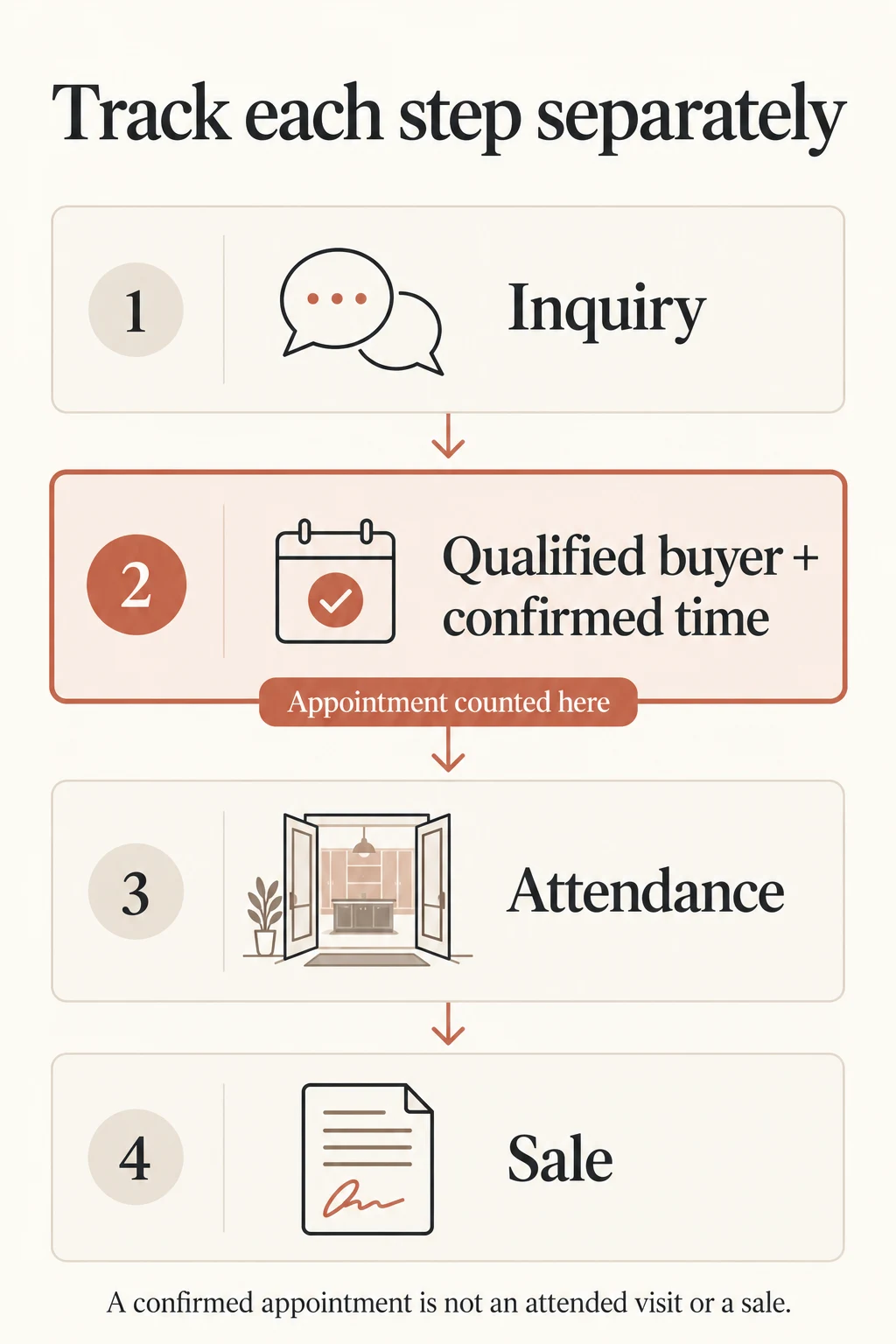
- Inquiry: a buyer asks about a project. A form fill alone is not an appointment.
- Qualified buyer and confirmed time: record the buyer, verified contact and agreed time. This is the counted appointment under the eligible showroom agreement.
- Attendance: record whether the buyer attended. A missed visit remains separate from the confirmed appointment count.
- Sale: record any accepted job separately. A booking does not establish revenue.
| Stage | What the record establishes |
|---|---|
| Inquiry | Someone has asked about a project. A form fill alone does not establish an appointment. |
| Confirmed appointment | A named buyer, verified contact and confirmed time. A qualified appointment counts when the buyer confirms a time. Attendance is tracked separately. The signed agreement defines your program’s scope. |
| Attended appointment | The buyer attended. Record this separately from the confirmation. |
| Won job | The team records an accepted sale and its value. A booking alone does not establish revenue. |
A handoff your designer can use
Illustrative example: a buyer has asked about replacing kitchen cabinets, provided contact details and confirmed a Tuesday appointment. The receiving team member records the project location, questions about layout and who will prepare for the visit. Attendance and any later sale remain separate fields.
Check capacity before opening more slots.
Write down available designer hours, time already committed, and the preparation, meeting and quotation work required for a new project. Use the remaining hours to decide which slots you can support. There is no universal number of appointments each designer should take.
Download the showroom checklistCheck the acquisition math →
For the next step, review current program fees and guarantee terms, see how CRM follow-up works, or use appointment reporting to keep the stages visible. The GBC Kitchen & Bath case is a named client’s experience, not a forecast for your showroom.