
Marketing for cabinet manufacturers.
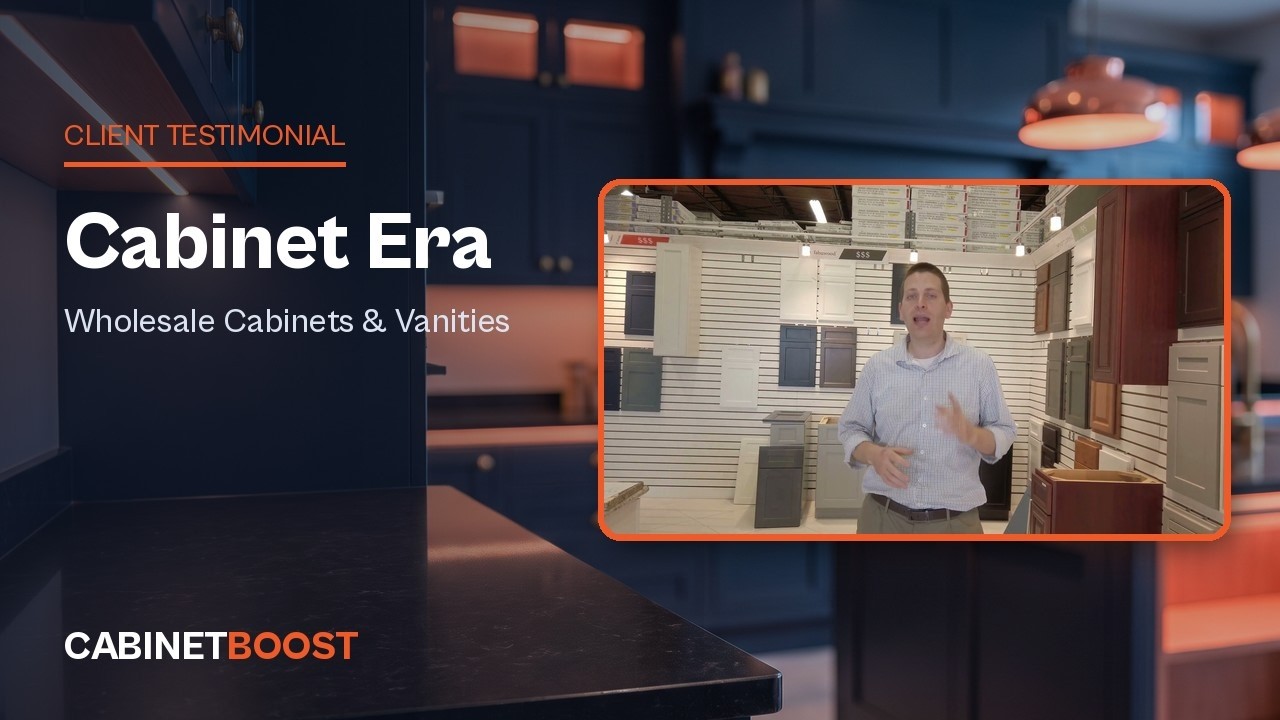
The dealer-network side of the market.
Cabinet Era is a stocking dealer—the kind of account a manufacturer recruits. This case shows dealer-side growth.
- Qualified dealer meetings A named dealer principal, builder, architect, or OEM buyer who has confirmed a meeting time.
- Territory and product fit Geographic and product-tier overlap checked against the dealer map before a conversation is booked.
- Opening-order readiness Whether the account can clear the volume or minimum-opening-order bar agreed before launch.
Measures are agreed before launch and reviewed against your dealer pipeline.
From target territory to a qualified account conversation
How a manufacturer reaches dealers and builders that fit the product line.
- Territory
Dealers, distributors and builders search for the product categories you make.
Who acts CabinetBoost - Fit
Accounts are filtered by territory, product line and volume fit.
Who acts Both - Conversation
A qualified trade conversation is booked for your sales team.
Who acts Both - Follow-up
Your team owns specs, quotes and closing the account.
Who acts Your team
CabinetBoost handles campaigns, content and routing; qualification and closing stay with your sales team.
The Manufacturer Playbook — what we do for plants and lines like yours 6 steps
Dealer principals and switching intent, not homeowner kitchen ads. Trade creative that books the sit with the rep, not a kitchen-remodel click.
Dealer principals and specifiers see the line between shows. Trade social that books the sit, not a like from a booth.
Construction details, finishes, lead times, territories — the pages a builder's estimator and a dealer principal actually read before they call.
Dealers, builders, and architects find the line. Not a homeowner kitchen remodel, and not the makers query that lives on cabinet-makers.
Dealer, builder, and architect searches land on a page that books a meeting, not a homepage. Negatives drop kitchen-remodel keywords off the calendar.
When someone asks for a cabinet manufacturer, the engines cite plants whose pages answer plainly. We build yours to be the answer.
Cabinet manufacturers need dealers who stock the line and builders who spec the plant
CabinetBoost builds manufacturers one demand system scored on qualified, confirmed dealer meetings for the plant and line rather than homeowner clicks, with one plant per territory. See the cabinet marketing services behind it.
More about this program
This is the page for marketing for cabinet manufacturers — the plant and the line. This page is for manufacturer owners: a factory, a line card, a dealer program, a spec package. You sit with a dealer principal comparing programs, a builder locking spec across units, an architect writing cabinets into drawings, a private-label or OEM buyer. The line plus dealer program plus spec package is the product, not a kitchen package, not a closet system, not a fabricated slab, not a shop-floor cabinet box, not a warehouse in-stock SKU. CabinetBoost takes one manufacturer per territory so two plants are not recruiting the same dealers.
The conversion is a booked dealer meeting: a named decision-maker and a confirmed time; meeting targets and counting criteria are agreed before launch. Territory, volume, product-tier fit. Not a click. Not a form fill. Not a kitchen showroom floor sit. Not a remodel estimate. Not a closet consult. Not a fabricator measure. Not a warehouse reorder sit.
Picture the line running on demand you booked — not luck. NKBA Member · KBIS 2026 Exhibitor · 7+ years in cabinet-industry marketing (CabinetBoost, 2026). The conversion this page counts is qualified dealer meetings for the plant and line — a dealer principal, builder, architect, or OEM buyer with a confirmed time to review the program and spec package; meeting targets and counting criteria are agreed before launch. By Sezgin Arslan, Founder · Updated Sep 14, 2026.
Picture the line running on demand you booked — not luck.
Not homeowner kitchen clicks. Not badge scans from the last show. Decision-makers at dealers and on spec teams — pre-qualified on territory, product tier, and volume — sitting with your reps.
- Dealer sits A rep calendar that stays full Named decision-makers with a confirmed time, qualified on volume, territory, and product-tier fit before they book. The slow month stops setting the plant's future.
- Spec work Builders who can cite the plant Job language, not a second offer: estimators and architects find construction details, finishes, and lead times, so the drawings name the line. Volume buyers, not one-kitchen homeowners.
- Confirmed sits The conversion is a sit Qualified dealer meetings for the plant and line — a dealer principal, builder, architect, or OEM buyer with a confirmed time to review the program and spec package; meeting targets and counting criteria are agreed before launch. Not a click. Not a form fill.
Sound familiar? 3
The line runs because two big dealers keep ordering. When a builder searches for a semi-custom line for sixty townhomes, the name never comes up — the plant's future rides on relationships one rep retirement could end.
Generic agencies send manufacturers kitchen-remodel leads. The team burns days routing one-kitchen homeowners toward dealers while the actual buyer — a dealer principal comparing programs, a builder locking spec — never finds the site.
New territories open when KBIS happens or a rep stumbles into a shop. Between shows, whitespace stays white — and a competitor's line card gets on the dealer's wall first.
What most cabinet manufacturers invest
Most cabinet businesses start between $2,500 and $5,000 per month (CabinetBoost, 2026). Manufacturer programs typically start at $5,000-plus per month depending on dealer count and territory. That is the CabinetBoost program fee. Ad spend is separate and stays in the plant's accounts. The first 90 days is a sprint; after that the engagement is month-to-month. The sanity check is one new stocking dealer, or the spec work that fills a line week. If that account is worth more than a month of program fee, the math is the owner’s, not a frozen multiple. CabinetBoost will not invent an unattached ROI multiple on this page.
Why manufacturer marketing isn't distributor marketing
If you run a warehouse or branch and the business is reorder share, start here: marketing for cabinet wholesalers and distributors. This page books qualified dealer meetings for the plant and the line.
The retail dealers you recruit have their own page: marketing for cabinet dealers.
If your growth is a design floor and a sit on the displays, start here: marketing for kitchen & bath showrooms.
If you run a custom shop and sell off the bench, start here: marketing for cabinet makers.
If you remodel kitchens and baths rather than recruit dealers to a line, use marketing for kitchen & bath remodelers. That page is built for the estimate book.
If you book closet consults rather than a dealer meeting, use marketing for custom closet companies. That page is built for the walk-in and the reach-in.
If you book fabricator measures rather than a dealer meeting, start here: marketing for countertop stores and fabricators.
Dealers on the record: reputation management. Fast follow-up so the dealer conversation books: AI chatbots. Weekly reporting: analytics. CRM so new dealer programs live in a pipeline, not a rep inbox: CRM setup. Campaigns go live after a fast kickoff. Most cabinet clients see the first booked conversation inside 14 days. Dealers still take weeks to switch a line card. The conversion is a qualified dealer meeting, not a one-week spike.
Who this isn't for
The guarantee only works when the fit is right — so we’re direct about who it’s not for.
If the plant cannot fulfill new dealer volume now, new accounts mean backorders and a damaged program. Stabilize capacity, then recruit.
If the whole pitch is lowest price, marketing will not fix a positioning problem. We work with manufacturers whose terms, quality, finishes, or lead times give a dealer a reason to switch — not the lowest box alone. We never gate photos or the strategy session on a public review.
This is a B2B plant program. If growth is a showroom floor or a dealer store sit, those leaves fit; a manufacturer pipeline full of one-kitchen homeowners helps nobody.
Manufacturer and plant terms we use on this page 28
- Line
- The program the plant sells. Dealers stock it; builders spec it.
- Plant
- The factory — where the line is built. Not the warehouse.
- Spec sheet
- Construction, finishes, dimensions, lead times an estimator can cite.
- Spec pages
- Published spec content a builder and an architect actually read.
- Dealer program
- Net terms, freight, damage-claim, SKU depth, territory rules.
- Dealer recruitment
- Finding dealers who stock the line.
- Builders
- Volume buyers locking spec. Job language, not a second offer.
- Architects
- Specifiers writing cabinets into drawings. Job language only.
- OEM
- A manufacturing partner for another brand.
- Private-label
- The plant builds under a retailer's or developer's name.
- MOQ
- Minimum order quantity. Volume qualification.
- Lead times
- How long the plant takes to ship.
- SKU depth
- How much of the line a dealer can stock.
- Net terms
- Payment terms the dealer weighs with freight.
- Freight program
- How product moves plant to dealer.
- Damage-claim
- How the plant handles freight damage.
- Product tier
- Where the line sits versus competing lines.
- Territory
- Geographic plus product-tier overlap. One manufacturer.
- Whitespace
- Markets where no dealer carries the line yet.
- Line card
- The lines a dealer stocks. A download is not a sit.
- Multifamily
- Builder work across units.
- Container volume
- Inbound supply the plant can fulfill.
- Construction details
- How the box is built. Estimators cite this.
- Finishes
- Colors and textures published for spec.
- KCMA
- A certification buyers check. Named as a term, not a claim.
- IWF
- A trade show. Growth that waits for IWF or KBIS is the pain.
- Dealer meeting
- Named decision-maker, confirmed time. The conversion this page counts; attendance is tracked separately.
- Qualified dealer meeting
- Named decision-maker, verified contact, confirmed time, relevant fit. The conversion this page counts; attendance is tracked separately.
Questions owners ask before they call.
Can you qualify dealer leads by minimum order quantity (MOQ)?
Yes. MOQ and volume thresholds are part of the qualification layer, and CabinetBoost agrees on them before launch. If the program needs container-level commitments or a minimum opening order, prospects who cannot clear that bar never reach the reps' calendars. A meeting only counts when it meets the criteria set together — named decision-maker, volume and product-tier fit — not a courtesy coffee and not a homeowner kitchen lead.
Do you protect existing dealer territories when recruiting new dealers?
Campaigns are built around the territory map from week one. Markets where a stocking dealer already carries the line are excluded or handled by the plant's rules — protected radius, product-tier splits, whatever the dealer agreements promise. The goal is whitespace: new markets, not channel conflict with the dealers who already stock the line. CabinetBoost does not run two overlapping manufacturer programs against the same dealer wall.
Does this work for private-label and OEM cabinet programs?
Yes. Private-label and OEM buyers — retailers, multifamily developers, national brands looking for a manufacturing partner — search and evaluate differently than stocking dealers, so the spec pages, campaigns, and qualification questions change with them. CabinetBoost has worked only in the cabinet industry for 7+ years; the buyer changes, the system does not. This is plant work, not a retail showroom program and not a warehouse reorder program.
How do builders and architects find a cabinet manufacturer for spec work?
Through search, AI answers, and the spec detail they need at 10 p.m. — construction specs, finishes, lead times, and a dealer or rep to call. CabinetBoost publishes the line's spec and dealer pages so estimators and designers can cite the plant in drawings, and runs campaigns on builder and multifamily intent so the conversation starts with the team. If the drawings cannot reference the line, the spec goes to whoever published the details.
How much does marketing for a cabinet manufacturer cost?
Most cabinet businesses start the CabinetBoost program between $2,500 and $5,000 per month. Manufacturer programs typically start at $5,000-plus depending on dealer count and territory. That is the program fee; ad spend is separate and stays in the plant's accounts. First 90 days is a sprint, then month-to-month. The test is whether one new stocking dealer, or the spec work that fills a line week, covers the month.
How fast will we start seeing booked dealer meetings?
CabinetBoost does not sell "leads." Campaigns go live after a fast kickoff; most cabinet clients see the first booked conversation inside 14 days. Dealers take weeks to switch a line card and builders take weeks to lock spec, so a one-week spike is not the test. Badge scans, line-card downloads, and courtesy coffees that never sit are not the measure. What counts is a qualified dealer meeting for the plant and line: a dealer principal, builder, architect, or OEM buyer with a confirmed time to review the program and spec package; meeting targets and counting criteria are agreed before launch.
How is manufacturer marketing different from distributor marketing?
A manufacturer needs dealers to stock a line and builders to spec the plant. A wholesaler or distributor needs stocking dealers and contractor accounts who reorder from the warehouse — share of reorders, warehouse turns, and the rep's calendar, not a spec sheet for the line. We run them as two different programs. If the business is the warehouse counter, the distributors page is the one you want; this page keeps the plant in front of volume buyers.
Should a cabinet manufacturer invest in Meta and LinkedIn, or Google Ads first?
If dealer recruitment is the gap, start with Meta Ads and LinkedIn plus trade content so dealer principals see the line between shows. If builders and architects cannot cite the plant, ship spec and dealer pages next. Google Ads on dealer and builder intent comes after the pages exist, so budget does not land on a homepage. CabinetBoost's manufacturer playbook uses that order; the job is still volume buyers, not homeowner kitchen clicks.
What's the ROI on marketing for a cabinet manufacturer?
What we book is a qualified dealer meeting for the plant and line — a dealer principal, builder, architect, or OEM buyer reviewing the program and spec package. Builder and spec work is part of that job, not a separate offer. Named proof is NextDAY Cabinets #1 rankings and Cabinet Era on the dealer side; those numbers stay on their own case pages. Closet and remodel numbers stay on the closets and remodelers pages.
Do you work with other cabinet manufacturers in my territory?
One manufacturer per territory. CabinetBoost confirms geographic and product-tier overlap. If it is taken, we tell you rather than run two plants against each other. Competing lines on the same dealer wall are why exclusivity matters. What we book for you is a qualified dealer meeting for the plant and line: a dealer principal, builder, architect, or OEM buyer with a confirmed time to review the program and spec package; meeting targets and counting criteria are agreed before launch. If you run a warehouse rather than a plant, the wholesale playbook lives on /for/distributors; remodel consultations live on /for/remodelers.
Qualified dealer meetings on your reps' calendars
Start with the free audit: we review how dealers and builders find the plant, then map the path to qualified dealer meetings for your reps.