
SEO for Kitchen and Bath Remodelers
Local SEO helps kitchen remodelers, cabinet makers and showrooms connect accurate business information with useful answers for their buyers. Start with the service you actually sell, the question a buyer needs answered and the evidence you can show. This guide helps you choose the next page or profile improvement and measure what happened.

The short answer
- Match the buyer question to an existing page owner before adding another URL.
- Keep an eligible Business Profile accurate; check the actual showroom or service-area setup.
- Build project evidence from verified work and permitted images, with useful details a buyer can assess.
- Measure visibility and customer outcomes separately. A click is not an appointment or sale.
- For the dedicated contractor implementation guide, see kitchen remodeling SEO.
Choose one observed problem: inaccurate business information, an inaccessible page, a missing buyer answer or an unmeasured inquiry path. Fix its existing owner, document the evidence and release date, then inspect both search reporting and the next customer stage. A checklist cannot promise a ranking, a timetable or a lead volume.
Not sure where your SEO stands? Our free growth audit covers your Google Business Profile, rankings, and site health, specific to cabinet and K&B businesses.
Why Local SEO Is Different for Kitchen & Bath
A nearby showroom search and a detailed remodeling question may need different answers. A Business Profile supplies practical visiting information, while a website can explain service scope, project constraints and how to evaluate options. Neither channel proves how ready the person is to buy.
Google describes local ranking mainly through relevance, distance and prominence. Complete and accurate information helps Google understand the business. Distance still matters; adding a list of distant cities does not create a local presence.
Allocate effort from your own evidence. If the profile has the wrong visiting information, correct it. If relevant visitors reach an existing service page but cannot understand the offer or contact you, improve that page. If no comparable project is documented, gather permission and facts before writing one. These are planning decisions, not measured ranking weights.
Compare useful outcomes from each source. Record the buyer question, the page or profile involved, the observed problem and the next change; keep unknown source data marked as unknown.
Is SEO for a Kitchen and Bath Showroom Different from SEO for a Kitchen Remodeler?
Yes. Choose the answer from the business model and the buyer task. The examples below are editorial planning suggestions, not query-volume findings or claims about a real client.
| Business and buyer question | Page owner | Original evidence to gather | Next action |
|---|---|---|---|
| Showroom: Can I see these products and book a visit? | Existing showroom or location page | Current displays, real visiting arrangements, product limitations and appointment process | Verify the profile and page agree, then test the booking path. |
| Remodeler: Have you handled a kitchen like mine? | Existing service page plus a relevant project page | Permitted photos, actual scope, constraints, material choices and who performed the work | Use the brief below; link the project from the relevant service owner. |
| Trade cabinet maker: Can you supply this specification? | Existing trade or product capability page | Confirmed materials, drawing requirements, territory and current ordering terms | Have the operations owner verify every capability and availability claim. |
Keep the remodeler implementation guide and the SEO service page as separate owners: one explains the work; the other helps a buyer evaluate hiring support.
What Should You Check Before Publishing?
A review order to adapt to the problem you observed, not a ranking-factor dataset or universal priority score.
Business information
Check firstEligibility, category, address or service area, visiting information and hours must describe the actual business.
Existing page owners
Match intentA service page explains the offer; a project page demonstrates a specific completed job; a guide helps someone decide.
Genuine reviews
Build trustGoogle says reviews and positive ratings can help local ranking. Reviews must reflect genuine experiences.
Original project evidence
Show the workDocument the actual scope, constraints, materials and decisions you can verify. Photos require permission and accurate attribution.
Technical access
Verify accessCheck that the intended page can be crawled and indexed, works on mobile and has a clear canonical owner.
Outcome tracking
Separate stagesSearch impressions, website clicks and customer outcomes answer different questions.
How Should You Review a Google Business Profile?
Check eligibility and accuracy before adding content. Google’s business representation guidelines distinguish a customer-facing storefront from a service-area business. A business that serves customers at their location should review whether its address must be hidden; do not create a profile for an unstaffed virtual office.
- Confirm the real business name, suitable categories, address or service area and customer-facing visiting information.
- Choose categories that describe the core business; do not add categories solely as keywords.
- Use accurate photos of the actual business or work with permission. There is no photo-count ranking promise in this checklist.
- Check current hours and contact details against the website and test the contact route.
- Use Google’s review guidance: invite honest feedback from genuine customers without incentives or selective positive-review requests.
- Assign someone to respond helpfully to feedback. Choose a response routine your team can maintain; a fixed reply deadline is not a ranking guarantee.
For each issue, record the source or screenshot, date checked, responsible person, proposed correction and acceptance check. Recheck the live profile or page after the change; an edit request is not proof the correction is visible.
What Evidence Does a Useful Project Page Need?
Choose the format that answers the buyer’s actual question; reuse the existing owner when its task matches.
"Kitchen Remodeling in [City]: Timeline, Cost & What to Expect"
Intent: Research"What Changes the Cost of a Cabinet Order?"
Intent: Commercial"Semi-Custom vs. Stock Cabinets: Which Is Right for Your Kitchen?"
Intent: Decision"[City] Kitchen Renovation: Before & After with Real Budget"
Intent: Social proof"Questions to Bring to a Kitchen Consultation"
Intent: Research"What to Expect at a Cabinet Showroom Consultation"
Intent: Appointment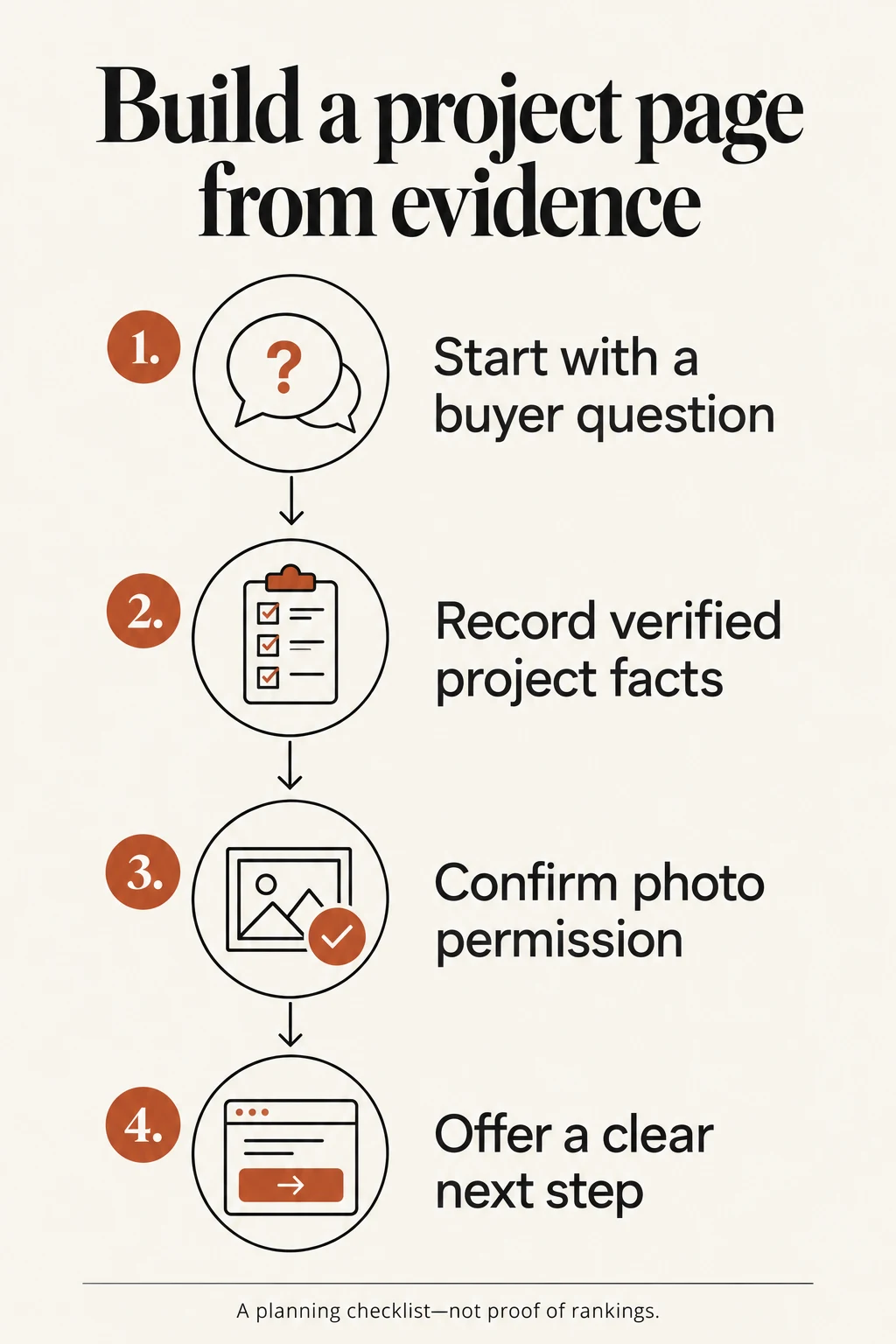
- Buyer question: name the decision the page helps someone make.
- Verified project facts: confirm scope, constraints, materials and responsibilities with the project owner.
- Photo permission: record rights and consent before publishing; omit private addresses and personal details.
- Clear next step: link the relevant service or consultation route and explain what the reader should prepare.
Copy this blank project evidence brief
Buyer question: ____; existing page owner: ____; actual scope and constraints: ____; verified materials or methods: ____; source and date checked: ____; photo rights and client consent: ____; facts still unknown: ____; reviewer: ____; next action: ____.
Fictional planning example, not a CabinetBoost client result: a remodeler receives questions about replacing cabinets while keeping a kitchen’s footprint. The brief calls for verified layout constraints, the reason for the cabinet choice, consented photographs and an explanation of what was retained. Budget, duration and customer outcomes stay absent until documented. No performance result is assumed.
Use the same record to choose the next fix
Observed problem: ____; evidence and complete date range: ____; profile or existing URL: ____; proposed change: ____; person responsible: ____; live acceptance check: ____; next review date: ____. For example, if your own inquiry records show buyers arriving outside visiting hours, compare the live profile with the actual appointment rules before commissioning more articles.
How Do Google AI Eligibility and Measurement Differ?
Google’s current AI optimization guidance says a supporting page must be indexed and eligible to appear with a snippet in Search. Normal SEO applies; no special AI file or schema is required. Make important information available as text and keep structured data consistent with visible content. Eligibility does not guarantee inclusion.
Review Google’s Search Generative AI performance report separately from the Web performance report. The dedicated report shows impressions for generative AI features; it does not supply query, click or CTR metrics. Inclusion must also be enabled for the property. Check the actual property’s Search generative AI setting and record whether inclusion is enabled. Do not infer that setting or AI-specific performance from an ordinary Web snapshot. For other platforms, keep a dated citation observation with the question, answer and linked URL. For a wider explanation, see the AI marketing guide.
For this owner’s review, compare explicit, complete date ranges for page and query impressions, clicks and CTR. Record indexing and crawl status separately. Then follow website inquiries, confirmed appointments, attendance and accepted jobs in the CRM with agreed definitions. Missing attribution is unknown, not zero; a visibility change alone does not establish a sales effect.
Related Guides
Kitchen & Bath SEO Questions Answered
Local SEO helps nearby customers discover an eligible business through Google Maps and Search. It includes accurate business information, useful service and project pages, genuine customer reviews, and a crawlable website. Visibility does not establish that a visitor is qualified or will book.
There is no reliable fixed timetable for a specific business. Record the issue, proposed change and release date, then compare complete reporting periods. Separate a technical fix being live from Google recrawling it, indexing it and changing its visibility; none guarantees the next step.
Choose queries that match services you actually provide and questions your buyers ask. Match each intent to an existing service, location or project page before creating another URL. A city name alone does not justify a separate page; original local details must help the reader.
An eligible showroom can use its Business Profile to show accurate location, visiting information, products, photos and reviews. Google describes local ranking mainly in terms of relevance, distance and prominence. No profile checklist guarantees a position or a share of leads.
Choose from the business problem, capacity and observed cost per qualified opportunity. Ads require budget and working tracking; SEO requires useful pages and ongoing maintenance. Compare your own completed inquiries and sales records instead of assuming either channel will deliver cheaper leads or a fixed launch timetable.
Publish information needed to make a real buying decision: what the showroom carries, how a consultation works, relevant comparisons and documented projects. Use the project evidence brief below to confirm facts and image permission. Improve an existing owner when it already answers the same question.
Yes, the reader task differs. A showroom visitor may need product availability and appointment information; a remodeler prospect may need scope, process and comparable completed work. A trade buyer may need specifications and ordering terms. Use those differences to choose page content, rather than assuming one ranking tactic fits every business.
Kitchen cabinet SEO connects actual buyer questions with accurate business information, useful service or project pages, and an accessible website. Measure search visibility separately from inquiries, confirmed appointments, attendance and accepted jobs. Keep unknown attribution visible rather than reporting missing data as zero.